AI Agents for Accounting
AI Agents for Accounting
AI Agents for Accounting
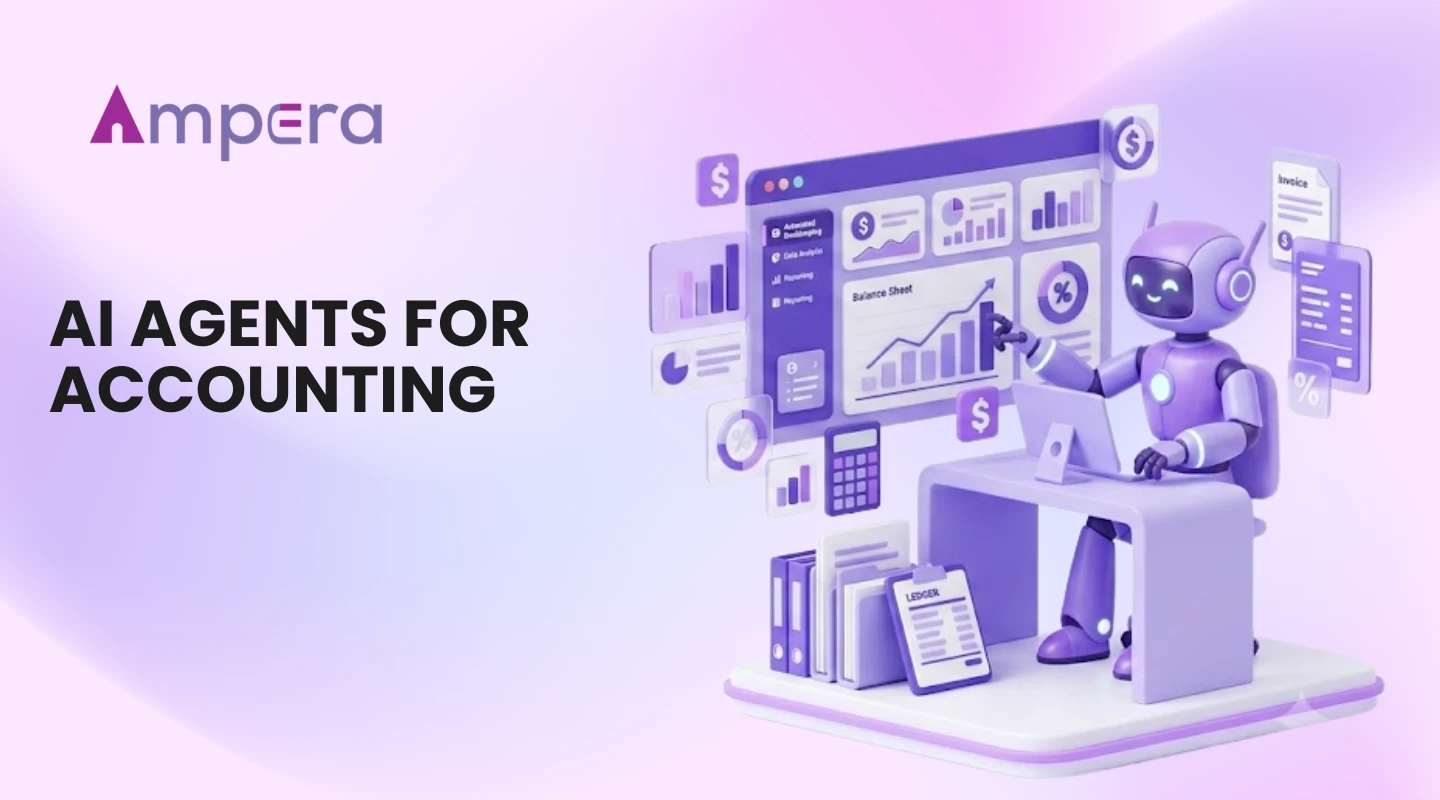
Automates repetitive accounting and finance tasks
Minimizes data entry errors
Facilitates invoices, expense management, payroll, and reconciliation
Is compatible with existing accounting software
Boosts real-time financial transparency
Increases security and workflow efficiency
Enables custom AI-powered accounting solutions
AI Agents for Accounting: Intelligent Finance AIgenerative AI solutions
The process of reconciliation and data entry, performed by AI agents, will allow your team to concentrate on planning rather than dealing with numerical data.
AI Agents for Accounting
AI agent means computer programs which perform accounting procedures automatically. Rather than doing these procedures manually at every stage, you let the AI agent execute tasks like reconciliation and invoice routing autonomously but within the constraints provided by your finance team.
You train them to do the analysis of receipts, classification of expenses and monitor the cash flow trends. These tasks are performed by intelligent systems in order to allow your employees to perform more complicated advisory activities. This technology brings calm consistency to your daily ledger management.
How AI Agents Transform Modern Accounting Workflows
Manual updating of the spreadsheet is time-consuming and error-prone. AI agents take over the task of bringing all of your isolated data points together in one cohesive flow. This is done in an efficient manner, where data is collected from emails, invoices, and bank feeds.
You no longer need to compare all the screens at the end of the month. Data is formatted, any missing data is marked, and the whole thing is ready for your review. Businesses looking to automate complex financial workflows can explore custom AI agent solutions that connect systems and reduce repetitive manual work.
Common Accounting Tasks AI Agents Can Automate
These gadgets handle all the mundane tasks that consume your valuable time. Here is how these gadgets assist you:
Bill processing: Programs extract information from bills and cross-check it with the purchase orders.
Expenditure recording: The program examines all expenditures incurred by the team and classifies them under the respective ledger account.
Bank reconciliations: Agents cross-check the company’s records with the records provided by banks and identify any differences right away.
Payroll preparation: Software does the computations for hours worked, makes the deductions, and calculates net pay; final figures and payouts must be verified by humans.
To understand how autonomous agents differ from traditional automation, read our guide to AI agents vs. rule-based systems
Key Benefits of AI Agents for Accounting Teams
With automation of the data entry process, mistakes will be avoided, and there will be an opportunity to utilize staff time in a more productive way. Rather than spending their time on tedious data entry tasks, employees will be able to analyze finances and provide consultations for clients.
How AI Agents Can Support Accounting Across Industries
Despite the universality of the principles of finance, accounting processes vary considerably from one industry to another. The configuration of AI agents according to the unique rules of each industry enables the finance department to resolve its major challenges.
Industry | Common Accounting Challenge | How AI Agents Support |
Retail | High transaction volume in physical POS and eCommerce payment gateways makes reconciliation difficult each day. | Automatically reconciles multi-channel sales reports with bank deposit amounts, reconciles merchant processing fees, and detects batch differences. |
Healthcare | Revenue recognition is hindered by reconciling complicated insurance claims, patient co-payments, and contract adjustments. | Matches insurance remittances with patient accounts, posts payment transactions, and sends denial claims to appropriate personnel for further action. |
Manufacturing | The changing cost of raw materials and different shipping terms make inventory accounting difficult as does the three-way matching of invoices. | Automates the three-way matching process of purchase order, delivery slip, and supplier invoice, maintaining real-time inventory value accounts. |
Real Estate | Recording of fragmented OPEX, maintenance costs, and CAM fees in relation to different properties and multiple bank accounts. | Auto-coding of vendor invoices to appropriate property ledgers, recovery of recoverable expenses, and verification of duplicate contractor invoices. |
The issue can be solved through aligning AI programs with account charting schemes specific to each industry and compliance requirements, thus leaving final approval up to company employees. For a related example of healthcare data transformation, explore Ampera's healthcare revenue cycle provider project
How AI Agents Integrate with Existing Accounting Systems
There is no need for you to dismantle the entire software stack in order to make use of the AI. Modern-day agents connect themselves to mainstream platforms through secure interfaces. This just means that the AI works in the background using the software solutions that you know.
The moment the agent is integrated, it will become an intermediary between your emails, banks, and primary ledger. The agent collects data from external sources and places it into your central software. You will be the one in charge of the final approval of the actions taken.
Challenges, Security, and Governance Considerations
Ensuring that sensitive information is well protected in case of adoption of AI agents needs strict security architecture. The organization should ensure four main protective measures while implementing AI agents. These include having strong access control mechanisms that implement least privilege access, end-to-end encryption of data, having good audit logging for all automatic entries, and ensuring human monitoring continuously.
Drawing of a line and making sure that administrative privileges remain in the hands of humans will allow finance people to be efficient.
How to Successfully Implement AI Agents in Accounting
To have a seamless roll-out with no impact on operations, adhere to the following approach:
Select a task with low risk: Choose a highly specific and repeatable process such as categorizing receipts or basic invoice matching.
Run the task: Diagram your process using your rules and conduct some initial runs.
Audit the output: Examine the output of the task conducted by the agent along with your team.
Scale in gradual steps: Increase autonomy and complexity of workflows as team confidence increases.
Why Businesses Are Choosing Custom AI Accounting Agents
Out-of-the-box software has trouble with specific logic, legacy infrastructure, and stringent data governance. Custom implementation helps overcome this problem through the design of AI agents that work within your infrastructure and logic. Utilizing custom agentic features of AI, Ampera develops custom production-ready agents for you.
Conclusion
Taking care of your finances does not need to be a source of stress and mistakes. AI solutions for accounting will allow you to manage your operations fast, accurately, and without worrying about anything. Through the automation of processes, you give your team more opportunities to concentrate on important strategic work.
FAQs
Can AI agents automate invoice processing?
Yes, they automatically capture vendor names, sums, and dates of transactions, compare this data with POs, and plan payments.
Can AI agents help reduce accounting errors?
Automation of repetitive tasks allows us to keep the process standardized and avoid routine mistakes that occur when inputting data manually.
Can AI agents integrate with existing accounting software?
Yes, AI agents are able to integrate with existing financial software via secure connections and read/write data in it.
Can AI agents assist with financial reporting?
They collect the needed data for creating reports very fast and provide exact results, like a weekly cash flow report or a monthly expenses report in seconds.

Founder & CEO of Ampera Technologies
Dr. Damodaran (Dan) Venkatesan is the Founder & CEO of Ampera Technologies, an AI agent development and digital transformation company helping enterprises, SMBs, and startups leverage artificial intelligence, automation, and data intelligence. With over 25 years of leadership experience across IT, Financial Services, and Academia in the USA, UK, and India, he has built and scaled innovative technology organizations that drive business growth and operational excellence. Prior to Ampera Technologies, he co-founded and led Ameex Technologies, a global digital services company that was later acquired by Perficient. He also spent more than a decade in leadership and technology roles at Motorola Inc. and Moneris Solutions in Chicago, USA. His expertise spans AI strategy, enterprise technology, digital transformation, and data-driven innovation.