Agentic AI vs Traditional AI
Agentic AI vs Traditional AI
Agentic AI vs Traditional AI
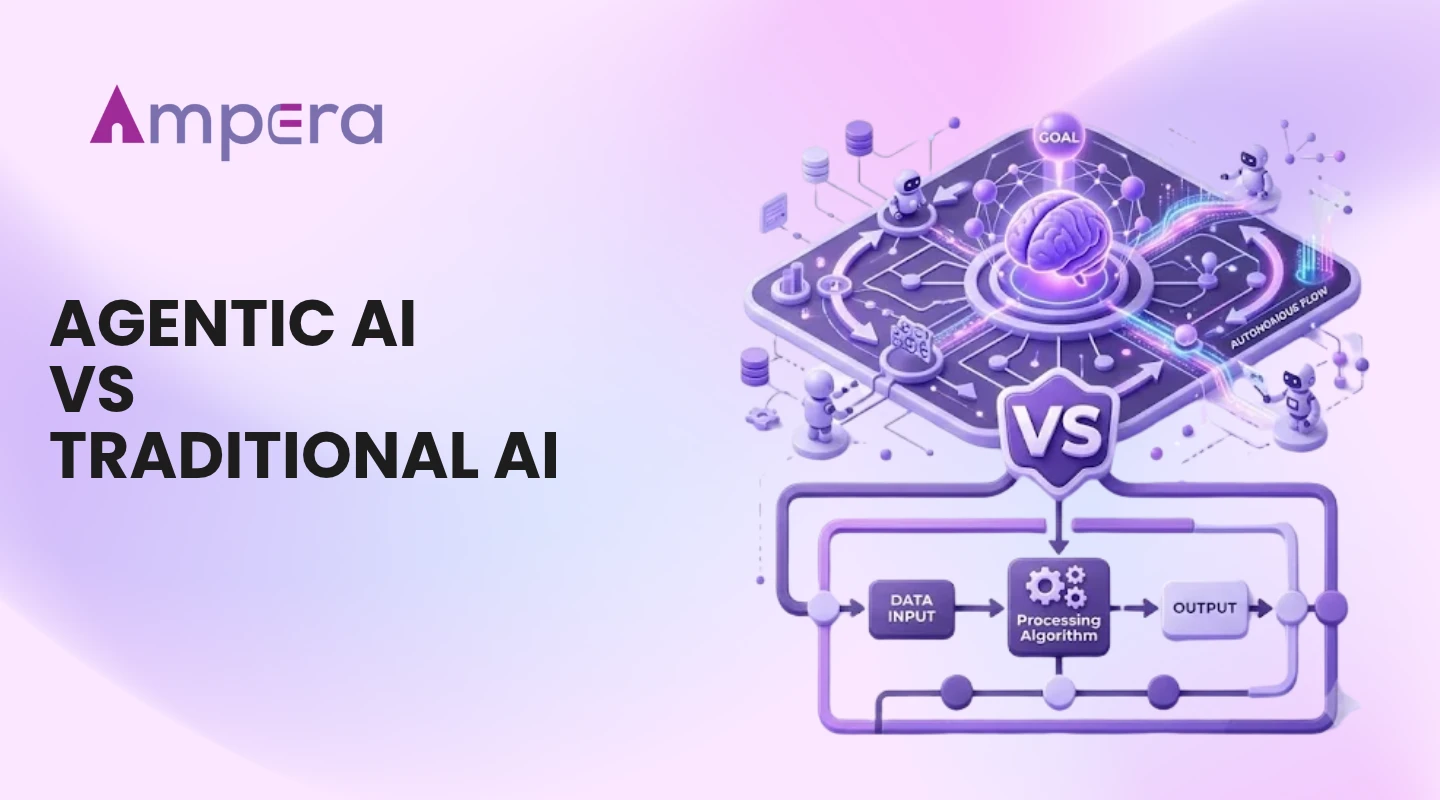
Traditional AI handles predictions, classification, and pattern recognition.
Agentic AI plans tasks, uses tools, and automates complex workflows.
Combining both supports efficient, secure, and scalable business operations.
When exploring modern software adoption, many teams hear about agentic AI and assume it immediately replaces all existing machine learning models.
As outlined in this Dataversity analysis on AI paradigms, decision makers face challenges in distinguishing between reality and hype in the market.
The ability to distinguish between the two technologies can help you adopt them safely without the need for risk.
Ampera Technologies creates enterprise level solutions that integrate both paradigms in a way that ensures the creation of strong workflows and competitive edge for your company.
What Is Traditional AI?
Traditionally, AI means machine learning models that are deterministic in nature, and these models learn from structured datasets to accomplish very limited tasks such as classification, regression, or pattern recognition. According to the Fullstack Labs on agentic distinctions as defined by Fullstack Labs, traditional AI models are heavily dependent upon rules and training data. They are good at prediction, anomaly detection, or risk assessment for a particular credit score based on existing parameters. But they do not have the capacity to reason independently or plan for multiple steps.
What Is Agentic AI?
Autonomous Execution is one of the aspects of Agentic AI as the systems are capable of planning, using tools, and performing complicated workflow through the utilization of large language models and reasoning loops without any human supervision all the time. As per GeeksforGeeks insights on AI architectures, agentic systems are capable of decomposing high-level goals into a series of tasks, assessing interim outcomes, and correcting mistakes in the real time. Unlike other systems, agentic systems work with external APIs, query databases, and coordinate applications.
Key Differences Between Agentic AI and Traditional AI
It is important to consider structural mechanics in order to comprehend the differences between these paradigms. As noted by Inspyr Solutions on technological differences, traditional AI operates reactively on isolated data points, whereas agentic AI operates proactively with goal-directed autonomy.
Feature | Traditional AI | Agentic AI |
Execution | Rule-bound, single-pass prediction | Autonomous, multi-step planning |
Adaptability | Fixed after training | Dynamic tool use and self-correction |
Scope | Narrow pattern matching | Complex workflow orchestration |
Human Role | Full oversight for exceptions | Strategic guidance and governance |
Organizations evaluating implementation options can compare the advantages and trade-offs of building vs. buying AI agents before selecting an approach.
When to Use Traditional AI vs Agentic AI
Selecting the appropriate paradigm is all about your operational choke points. Select traditional AI for tasks where fast and repeatable classifications or predictions need to be done on neat tabular data. Fraud detection systems that classify millions of transactions in a second are examples of tasks that use traditional machine learning. On the other hand, select the agentic workflow in situations where coordination across multiple systems, document composition, and decision-making are needed.
Business Use Cases Across Industries
The various sectors employ these technologies to address their respective concerns. In insurance, traditional technology focuses on assessing risk scores, while the agentic model performs claim verification through comparing the contents of the policy with outside database information.
In healthcare, the traditional technology is used for the analysis of diagnostic images, while the agentic one is used for scheduling appointments and retrieving patient records. Healthcare organizations can also learn how autonomous systems support healthcare workflows in this guide to AI agents for healthcare
Security operations combine traditional threat detection with agentic incident response coordination.
Manufacturing facilities that use semiconductors make use of both traditional maintenance systems and agentic supply chain systems. Companies in the CPG industry adopt both traditional demand forecast techniques and agentic negotiations with retailers.
Finally, education platforms use traditional adaptive learning algorithms and agentic tutoring assistants.
Benefits and ROI of Agentic AI and Traditional AI
Use of appropriate AI system provides concrete operational benefits. Conventional machine learning system cuts down the time needed to process huge volumes of data manually. Agential system increases efficiency due to the fact that it processes unstructured workflow, which used to be coordinated by multiple departments in the past. With the right use of such systems, your business will get benefits in form of decreased operational costs, increased speed of operations and effective resource distribution.
Challenges and Implementation Considerations
The adoption of sophisticated intelligence systems requires a lot of planning regarding data security, privacy, and system architecture. It is important to come up with stringent data management policies to ensure that any sensitive data is secure. In addition to this, it is imperative to adopt human-in-the-loop approaches, which make sure there is accountability whenever the autonomous agent performs any transaction. Standards such as VPAT and WCAG 2.2 AA should also be adopted in order to ensure accessibility.
Common Mistakes to Avoid
Organizations often fall into the trap during adoption in failing to address the basics. Ensure that you don’t implement any autonomous agent without adequate monitoring and evaluation systems.
Don’t ever presume that an off-the-shelf system satisfies your compliance requirements without sufficient tests. In addition, never ignore human decision-making processes when the situation is important as it might happen for autonomous systems to make errors in interpreting some ambiguous business rules.
How to Choose the Right Approach for Your Business
While assessing potential partners or even developing capability internally, there should be the asking of specific questions rather than going for broad lists of features.
Ask your potential partner:
What kind of AI models have you developed before?
How do you determine whether to fine-tune or retrieve?
How do you keep private and sensitive information safe?
How do you measure and manage your AI system post-deployment?
Are you prepared to update your corporate architecture?
Get your AI Partner Evaluation with Ampera today.
Conclusion
The combination of conventional machine learning techniques and agentic capabilities will enable your firm to tackle both structured prediction problems and unstructured workflow automation problems. This is only possible through ensuring that there is good data governance, proper human intervention, and sound evaluation metrics. Through creating a road map, you will be assured of scaling up in the long run.
FAQs
Is agentic AI better than traditional AI?
Neither is inherently better since each is more adept at performing certain operational tasks. The former performs well in classification, while the latter excels in complex and multi-step reasoning.
Can traditional AI and agentic AI work together?
Yes. Advanced architectures leverage the strengths of both types, where the former acts as the scoring engine and the latter as the decision engine.
Is agentic AI more expensive to implement?
In terms of the cost of initial setup, yes. Complex reasoning loops and API integration make traditional AI cheaper to implement.
Which is better for automation?
While traditional AI works best for automated processes, agentic AI is better at dynamic workflows and automated reasoning.
Does every business need agentic AI?
No. Businesses with straightforward reporting or simple automation needs achieve optimal results using traditional software and machine learning models.

Founder & CEO of Ampera Technologies
Dr. Damodaran (Dan) Venkatesan is the Founder & CEO of Ampera Technologies, an AI agent development and digital transformation company helping enterprises, SMBs, and startups leverage artificial intelligence, automation, and data intelligence. With over 25 years of leadership experience across IT, Financial Services, and Academia in the USA, UK, and India, he has built and scaled innovative technology organizations that drive business growth and operational excellence. Prior to Ampera Technologies, he co-founded and led Ameex Technologies, a global digital services company that was later acquired by Perficient. He also spent more than a decade in leadership and technology roles at Motorola Inc. and Moneris Solutions in Chicago, USA. His expertise spans AI strategy, enterprise technology, digital transformation, and data-driven innovation.