Agentic AI vs Generative AI
Agentic AI vs Generative AI
Agentic AI vs Generative AI
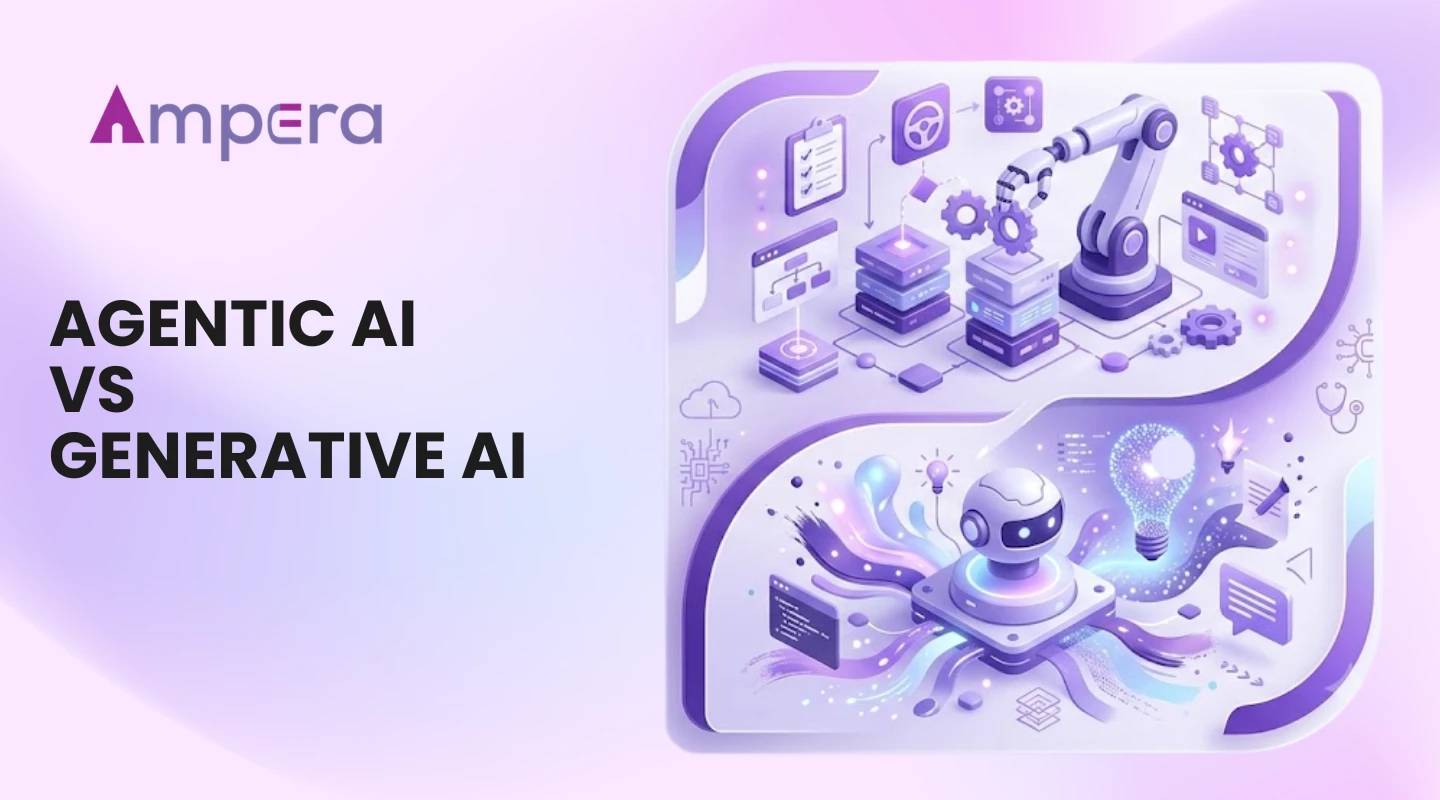
Generative AI creates text, images, code, and summaries from prompts.
Agentic AI plans tasks, uses tools, and executes multi-step workflows.
Businesses can combine both for content generation and workflow automation.
The basic distinction between Generative AI and Agentic AI lies in output vs. execution: Generative AI produces content from prompts, whereas Agentic AI achieves goals by executing autonomously multiple-step goals.
What Is Generative AI?
The tool utilizes language models and training data to detect patterns. The minute you enter a prompt, the tool automatically creates an appropriate response.
It can be used for writing, graphics creation, and even programming by creating the required code in a few minutes.
The main purpose of the software is assistance. Human involvement is needed to start the process and analyze the results of its work. For example, the tool creates an email message, but it is up to you to press send.
In case you want to create custom solutions for content generation, cooperation with a generative AI development company will be useful for you since such models will save much time per week for your team.
What Is Agentic AI?
Agent-based intelligence is oriented towards task completion as opposed to content creation.
While capable of planning and solving problems in a sequential manner, it cannot be regarded as autonomous since the operations of such an agent depend on constraints, permissions, and human oversight.
The agent is responsible for carrying out the entire process required
As one example, even though it is possible for a researcher to gather market data and develop a well-organized spreadsheet on their own, the analysis will be handed over to an analyst before the process of using email communications is started.
Developing agentic AI requires a combination of automation and monitoring. If you are planning on building an agentic AI, working with an AI agentic development company can provide assistance in creating your own unique agent.
Agentic AI vs Generative AI: Key Differences
The generative AI versus agentic AI debate can be understood through a comparison of their practical applications. The key distinction is in autonomy, whereby generative AI requires constant human input, and agentic AI works autonomously once a target is set.
Dimension | Generative AI | Agentic AI |
Primary Focus | Generating content (text, code, synthetic data, media) | Orchestrating and completing multi-step goals |
Operational Model | Prompt-and-response (turn-based) | Iterative (perception, planning, tool usage, action) |
Autonomy Spectrum | Direct guidance; typically single-turn or conversational | Goal-oriented; can execute subtasks within set parameters |
Output Type | Content, code, structured data, or application logic | Actions, executed workflows, and system updates |
Human Involvement | Continuous steering and manual prompt iterations | Defining objectives, establishing guardrails, and oversight |
Primary Use Cases | Drafting, summarization, research, and asset generation | Complex process automation, system integration, triage |
The ability to distinguish between generative AI and agentic AI allows you to apply the right technology.
For instance, when you want to formulate a marketing strategy, you will use generative AI, but for implementation on various platforms, agentic AI is what you need. Both serve entirely different operational needs.
Benefits and ROI of Agentic AI and Generative AI
Both technologies have their own strengths that can be used to the advantage of business activities:
Advantages of generative AI:
Higher efficiency: Makes work and communication within the team more efficient.
Brainstorming and creativity: Helps with idea generation and structure development for complicated subjects.
Time saved in the administration process: Saves many hours of employees’ time that would otherwise be used for writing routine documents.
Agentic AI promotes more efficient workflows and operations:
Process automation with multiple steps: Combines separate processes into an integrated workflow that minimizes manual interaction between systems.
Action based on data: Uses data obtained from various platforms to perform repetitive tasks according to predefined guidelines.
Scale in operations: Assists companies in managing greater transaction and process loads without an equivalent increase in administrative burden.
To summarize, Generative AI provides an instant efficiency boost to single content and communications tasks, whereas Agentic AI provides long-term efficiency and savings from optimization of multi-step business processes.
Challenges and Considerations Before Adoption
A well-thought-out plan for implementation is needed to ensure success and should strike a balance between protective measures and organizational readiness.
One such aspect is data security, which involves setting up secure data management systems, controlling access, protecting the privacy of the data, and having effective AI policies to manage the handling of information.
The other important aspect is the total cost of ownership, which includes software licensing, infrastructure integration, and maintenance.
Finally, team enablement is critical because employees must be trained to correctly implement the processes.
Before implementation, businesses should evaluate the trade-offs involved in building vs. buying AI agents, considering development costs, integration requirements, security, and ongoing maintenance.
Common Mistakes to Avoid
Ensure that you do not commit the following mistakes in your AI transition journey:
Data quality ignorance: AI depends on clean data for its effectiveness. Incomplete data produces poor results.
Too big steps: Don’t try to automate everything at once. Begin with pilot projects.
Human involvement ignorance: Autonomous agents need human input from time to time.
How to Choose the Right AI Approach for Your Business
To decide between Generative and Agentic AI, consider these seven considerations:
Usage scenario: Content creation vs. performing the job.
Complexity of workflow: Single prompt processing vs. multistep and branching flows.
Integration: Stand-alone app versus complete integration with CRMs, ERPs, and databases.
Degree of automation: Copilot functionality vs. self-execution.
Data and security concerns: General-purpose data vs. controlled access and guardrails for personal data.
Human supervision: Prompt-by-prompt validation vs. exception-based validation points.
Costs: Subscription-based and cheap SaaS models vs. higher engineering costs.
Comparing AI agents and rule-based systems can help businesses determine whether their workflows require adaptive, goal-oriented execution or predefined automation.
Conclusion
To conclude, Generative AI should be chosen if fast content writing and summarizing is important for you, while Agentic AI will be better if you want to automate operational workflows consisting of multiple steps. If you need more sophisticated applications, then the use of both types of AI will provide the maximum effect.
FAQs
Is agentic AI better than generative AI?
Neither of them is better. Their uses are different. Agentic AI assists in process automation, while generative AI creates content.
Can generative AI and agentic AI work together?
Yes. Absolutely. The Agentic AI system can employ generative AI to write an email as part of a greater workflow process.
Which is more useful for business automation?
Agentic AI will work better for automation in businesses since it can carry out planning and execution of processes all on its own.
Is agentic AI more expensive to implement?
Yes. Agentic AI needs an elaborate system in place that works seamlessly with the systems you already have.
Which industries benefit most from agentic AI?
Industries that have complex workflow processes, like finance, healthcare, logistics, and customer service.

Founder & CEO of Ampera Technologies
Dr. Damodaran (Dan) Venkatesan is the Founder & CEO of Ampera Technologies, an AI agent development and digital transformation company helping enterprises, SMBs, and startups leverage artificial intelligence, automation, and data intelligence. With over 25 years of leadership experience across IT, Financial Services, and Academia in the USA, UK, and India, he has built and scaled innovative technology organizations that drive business growth and operational excellence. Prior to Ampera Technologies, he co-founded and led Ameex Technologies, a global digital services company that was later acquired by Perficient. He also spent more than a decade in leadership and technology roles at Motorola Inc. and Moneris Solutions in Chicago, USA. His expertise spans AI strategy, enterprise technology, digital transformation, and data-driven innovation.